Blog Post #5: Parables
1. What specific things did you learn from your group's parable?
My parable was the Laborers in the Vineyard, which was a parable I had never heard before. I learned that this parable is about a group of workers that were upset that they received the same pay as workers who worked less than them. The boss replied to their upsets by saying that everyone including them agreed to work for one denarius, that he can choose who he is generous to, and that he has the right to do what he wants with his money. From this
parable I learned that God chooses who he sheds mercy on, we cannot choose for him or be upset that one person receives mercy from God. I also learned that you can't be upset if someone puts in less work than you, but gets the same reward because you both agreed to receive the same award. This story goes hand and hand with group work because one person might not be doing the same amount of work as you, but you both get the same grade. In the same way that the workers went to the boss, you should go to the teacher and tell her that the person is getting the same reward but did not do the same amount of work. It is the teachers choice who she sheds her generosity on.
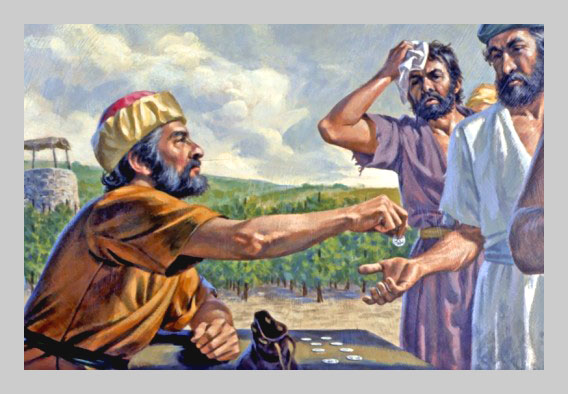 |
| This is a picture of the laborers, each receiving one denarius, which is what they agreed upon. |
2. What specific things did you learn from the parables that were presented by the other groups?
I learned many things from the other parables that were presented by the other groups. From the Parable of the Unforgiving Servant I learned to forgive those who did you wrong. When someone does a good deed for you, you should do a good deed for someone else and shed mercy on other people because you have no right to be rude to others. I learned to forgive and forget because that good in someone else's life can help them better other
people's lives. From the parable of the Prodigal Son I also learned forgiveness, in addition to rejoicing about how God helps us find ourselves in times we have lost hope. In the parable of the Sower I learned that we all have choices about which paths we choose, and we should choose the right paths. I like to think that I choose the "good ground" which the seeds that grew were planted in. I listen to God and look to him in times of need. From the parable of the Rich Man and Lazarus I learned to always be grateful for what you have, even if you don't have a lot. All God cares about is if you are grateful for what he gives you and that you are not selfish when people come to you for help.
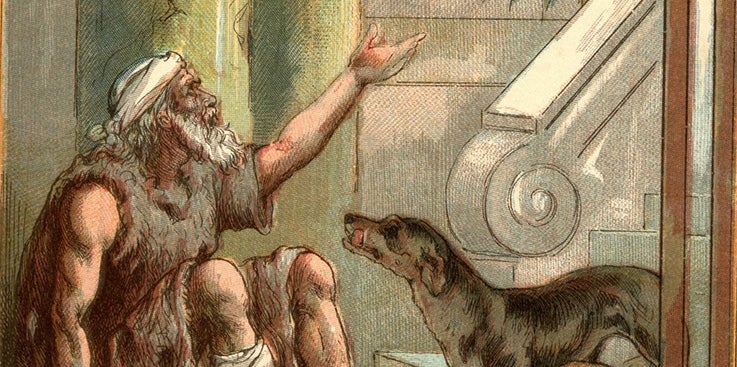 |
| The poor man from the Rich Man and Lazarus is begging the rich man for money, but he never is ungrateful for what he has. |
3. Which moral/lesson impacted you the most and why?
 |
| This image tells the story of the Rich Man and Lazarus. This parable has taught me to be thankful for what have and generous with what I have. |
4. What do you think it would be like if Jesus were in our society today?
If Jesus was in our society today, he would be telling parables about war, religion, technology, thankfulness, and many more things. I think that there are as many and if not more problems today in our world that back when Jesus was living. These problems are very different and Jesus would tell the parables in a different way because human lifestyle has changed and modernized. Many people today are carried up in technology because that is the lifestyle. I feel that Jesus would tell us a parable about putting down our technology and looking to the things that God blessed us with like the Earth and the people around us. Jesus would tell parables about how we should be accepting of everyone and not stereotype people into what society tells them to be stereotyped as. We should help others in need, not tell them to get up and work for themselves. There are so many conflicts and problems that Jesus could fix with power of telling parables, if he were in our society today. The changes he would make would be spectacular.
 |
| If Jesus was in today's society, he would be telling parables about how we need to lower our technology use and take care of Earth, the best blessing that God has given us. |
Bacon, Lena. "The Prodigal Son." Bible Archaeology Presentations, 2 November 2017, Notre Dame High School, Room 250,
Belmont, CA. Google Slides Presentation.
Gellner, Leilani. "Parable of the Sower." Bible Archaeology Presentations, 2 November 2017, Notre Dame High School, Room 250,
Belmont, CA. Google Slides Presentation.
Belmont, CA. Google Slides Presentation.
Gellner, Leilani. "Parable of the Sower." Bible Archaeology Presentations, 2 November 2017, Notre Dame High School, Room 250,
Belmont, CA. Google Slides Presentation.
Macha, Madison. "Parable of the Unforgiving Servant." Bible Archaeology Presentations, 2 November 2017, Notre Dame High
School, Room 250, Belmont, CA. Google Slides Presentation.
Macha, Madison. "Parable of the Unforgiving Servant." Bible Archaeology Presentations, 2 November 2017, Notre Dame High
School, Room 250, Belmont, CA. Google Slides Presentation.
Cunningham, Tessie. "The Rich Man and Lazarus." Bible Archaeology Presentations, 2 November 2017, Notre Dame High School,
Room 250, Belmont, CA. Google Slides Presentation.
“The Parable of the Laborers in the Vineyard From a First Century Cultural Perspective Mt.20:1-16.” Main, www.bettyscheetz.com/parablelaborers-
vineyard-first-century-cultural-perspective-mt-201-16/.
“Questions & Answers.” Truth About Death, www.truthaboutdeath.com/q-and-a/id/1596/what-about-the-rich-man-and-lazarus.
“Rich Man and Lazarus.” Wikipedia, Wikimedia Foundation, 27 Oct. 2017, en.wikipedia.org/wiki/Rich_man_and_Lazarus.
“Jesus.” Wikipedia, Wikimedia Foundation, 4 Nov. 2017, en.wikipedia.org/wiki/Jesus
Room 250, Belmont, CA. Google Slides Presentation.
“The Parable of the Laborers in the Vineyard From a First Century Cultural Perspective Mt.20:1-16.” Main, www.bettyscheetz.com/parablelaborers-
vineyard-first-century-cultural-perspective-mt-201-16/.
“Questions & Answers.” Truth About Death, www.truthaboutdeath.com/q-and-a/id/1596/what-about-the-rich-man-and-lazarus.
“Rich Man and Lazarus.” Wikipedia, Wikimedia Foundation, 27 Oct. 2017, en.wikipedia.org/wiki/Rich_man_and_Lazarus.
“Jesus.” Wikipedia, Wikimedia Foundation, 4 Nov. 2017, en.wikipedia.org/wiki/Jesus

Comments
Post a Comment